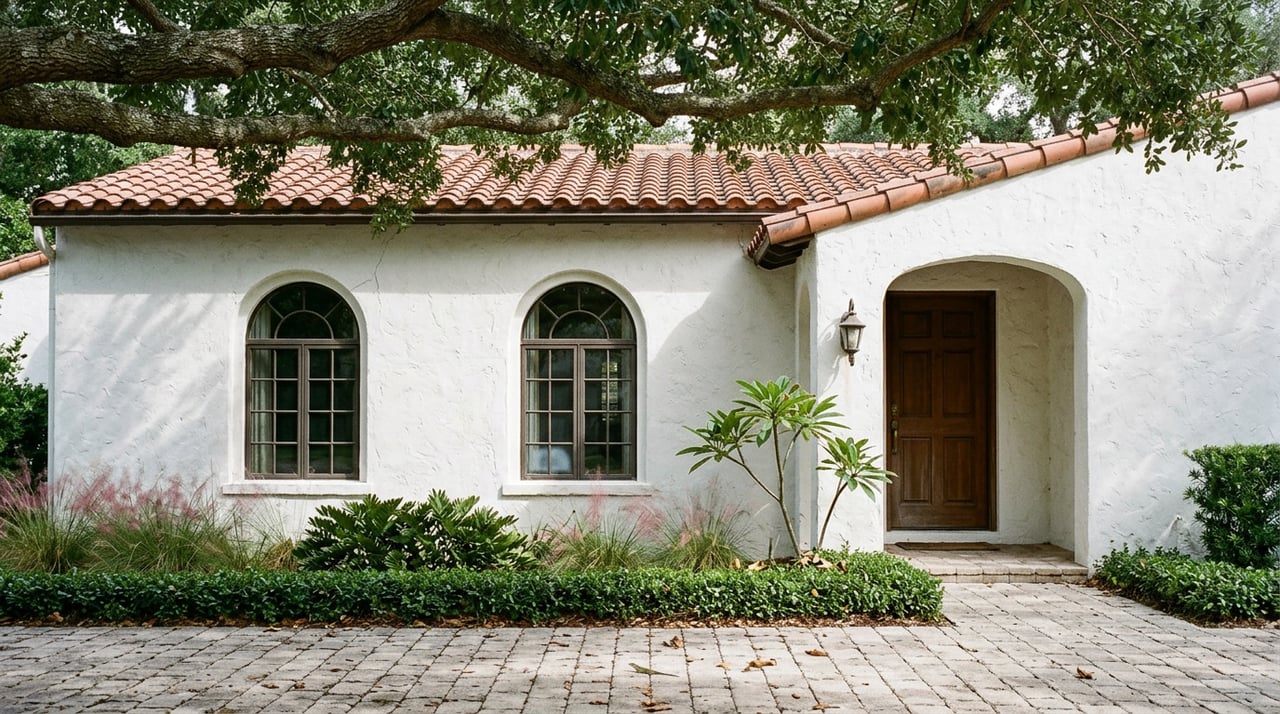
Drive west on Palmetto Park Road past the barrel-tile roofs and wrought-iron balconies of Old Floresta and you will pass a low, glass-fronted stucco building shaded by palm and pine trees, the kind of structure easy to file under "near the art school" without asking why an art school sits on a residential block in Boca Raton's oldest neighborhood. The honest answer surprises most people who have lived here for years: that building was not built to support the museum. For nearly four decades, it was the entire museum.
Old Floresta earned its designation as Boca Raton's first Historic District in 1990, a status tied to a story that began in October 1925, when architect Addison Mizner announced construction of homes for his company executives and his brother, the Reverend Henry Mizner, according to the historical marker placed by the Boca Raton Historical Society. The Robinson Company won the contract to build 29 Mizner-designed houses, but the 1926 collapse of the Florida land boom bankrupted Mizner's development corporation before construction finished. Chicago investor Hermann von Holst, who held the mortgage, completed the unfinished homes and gave the subdivision its name: Floresta, Spanish for "a delightful rural place."
That history explains the houses. It does not explain the building most residents walk past without a second look, because that building's story starts somewhere else entirely.
How a $6,000 Parcel Became the Whole Museum
Boca Raton's art institution began in 1950 as the Art Guild of Boca Raton, founded by a small group of residents after an impromptu library open house drew an unexpected crowd for a borrowed painting exhibition, according to the museum's own history. For a decade the Guild operated without a permanent home. That changed in 1960, when Ada MacKidd donated a parcel valued at $6,000 in Old Floresta, on West Palmetto Park Road. The Guild purchased five adjacent lots, on land that had previously held a radio station, WFLA, funded by the Mizner Development Corporation and later used for wartime radio communication.
Construction began in 1961. The Guild dedicated its new building in the fall of 1962: a one-story, glass-enclosed stucco structure that the founders built around the palm and pine trees already standing on the site rather than clearing them, a detail the museum still notes in its own account of the building's origins. That structure became the Art Guild's home, and later the Boca Raton Museum's home, for nearly 40 years.
Then and Now
The building at 801 W. Palmetto Park Road has held two very different jobs since 1962, separated by a single move across town in 2001.
| 1962 | 2026 | |
|---|---|---|
| Occupant | Boca Raton Art Guild, renamed the Museum in 1985 | Boca Raton Museum Art School |
| Function | Small permanent collection and rotating exhibitions | Working studio campus, no permanent collection on-site |
| Weekly programming | Guild meetings and periodic shows | More than 100 classes each week |
| Instructors | Volunteer membership | More than 50 professional faculty |
| Annual participation | Not tracked at this scale | More than 6,000 students enrolled per year |
The contrast is not decline. It is a handoff. The building went from housing a small, growing collection to running a full studio operation, and the second job has turned out to be the busier one.
Why the Museum Left, and Why the Building Didn't
By the late 1980s the Boca Raton Museum of Art had outgrown Palmetto Park Road. The board committed to a new facility in Mizner Park in 1997, and that building opened to the public on January 22, 2001, under director George Bolge, giving the museum 44,000 square feet of exhibition and education space designed by architect Donald Singer. The permanent collection, the changing exhibitions, and the museum's public identity all moved two miles east.
What happened next is the part most neighborhood guides skip. The Old Floresta building was not sold, demolished, or converted into something unrelated to art. The Art School moved into the former galleries and kept operating, and it has occupied that same footprint continuously ever since. Counting from the 1962 dedication, the building has now hosted uninterrupted art programming for more than 63 years, first as a museum and then as a school, which means the structure has spent more consecutive years in art use than most residential buildings in Old Floresta have spent under a single owner.
What's Actually Happening There Now
Walk into the building on any weekday and you will find working studios rather than gallery walls. The Art School's current curriculum spans eleven creative disciplines: ceramics, sculpture, painting, textiles, multimedia, photography, ikebana, and jewelry design among them, taught across morning, afternoon, and evening sessions seven days a week. The sculpture garden the founders built around those original palm and pine trees is still in use for outdoor classes and informal gatherings, part of what the museum describes as a park-like setting that continues to shape how the campus functions.
For a resident of Old Floresta, the practical version of this history is simple. A working art campus with over a hundred weekly class sessions sits inside walking distance of the neighborhood's tree-lined streets, open to adults, teens, and children at every skill level, with course sign-ups handled directly through the school rather than requiring museum admission. It is a resource many neighbors already sense is there and few have reason to look into unless they happen to be searching for a ceramics class or a place to send a curious ten-year-old on a Tuesday afternoon.
A Building Older Than Its Own Neighborhood's Protection
Here is the detail that reframes the whole story. Old Floresta's historic district designation dates to 1990. The Art Guild's building was dedicated in 1962, twenty-eight years earlier. The structure most people assume is a modern addition tucked next to a historic district actually predates that district's official protected status by nearly three decades, even though it is architecturally distinct from the 1925 Mizner houses that earned the neighborhood its name.
That timing matters because it means the building was never retrofitted into Old Floresta's identity after the fact. It was already there, already serving the neighborhood, before the city decided the surrounding streets were worth formally preserving. The homes gave Old Floresta its name and its historic status. The building gave it something the paperwork never mentions: more than 63 years of continuous, hands-on creative use, sitting on the same five and a half lots Ada MacKidd helped assemble in 1960.
Most people who live on Hibiscus Street or Oleander Street know their own house's history in some detail. Far fewer know that the low building at the edge of the neighborhood carried the entire Boca Raton Museum of Art on its back for nearly forty years, and that its second act, quieter but busier, is still running today.
For residents who want to see it firsthand, the Art School posts its current class schedule and studio offerings directly through the Boca Raton Museum of Art, and enrollment is open to the public year-round.
Understanding the layered history behind a neighborhood, not just its architecture or its address, is part of what makes Old Floresta worth paying attention to beyond the obvious. If you have questions about this pocket of East Boca Raton, or about property here, Jared Niles welcomes the conversation. Let's Connect.